Disclaimer: this article may contain affiliate links, and I may receive a commission on sales when you use those links, at no additional cost to you. I only recommend products I use and genuinely love.
The Xoloitzcuintli (or “Xolo”), with its ancient lineage, striking hairless appearance, and calm demeanor, is a definitely a dog breed that turns heads. For people with disabilities (like myself), the allure of a unique, deeply bonded companion that can also perform vital tasks is a very compelling idea.
As an owner of one of these exotic-looking dogs, this leads to a common question I frequently hear training dogs in the greater Seattle area:
“Can a Xoloitzcuintli be a service dog?”
The short, legal answer is yes. In theory, any dog breed can be a service dog if the individual dog is trained to perform specific tasks to mitigate a disability and can behave to a certain standard in public.
The practical, real-world answer is more nuanced. While a Xolo can be a superb service dog for the right handler and the right tasks, they are not a one-size-fits-all solution. This article will provide a balanced, in-depth evaluation of the Xoloitzcuintli as a service dog prospect, examining their temperament, physical capabilities, and the unique challenges they present in both advanced obedience and task training as well as realistic expectations for public access work.
Part 1: Understanding the Service Dog Standard
Before I really dive into breed specifics, let’s establish what we’re asking of a service dog. It’s a two-part job:
1. Task Work: The dog must be trained to perform at least three specific tasks that directly mitigates their handler’s disability. Examples include:
- Providing Deep Pressure Therapy (DPT) for PTSD or anxiety.
- Alerting to a medical event like a panic attack or blood sugar drop.
- Retrieving medication, a phone, or other important objects.
- Providing mobility support (a complex area we’ll discuss later).
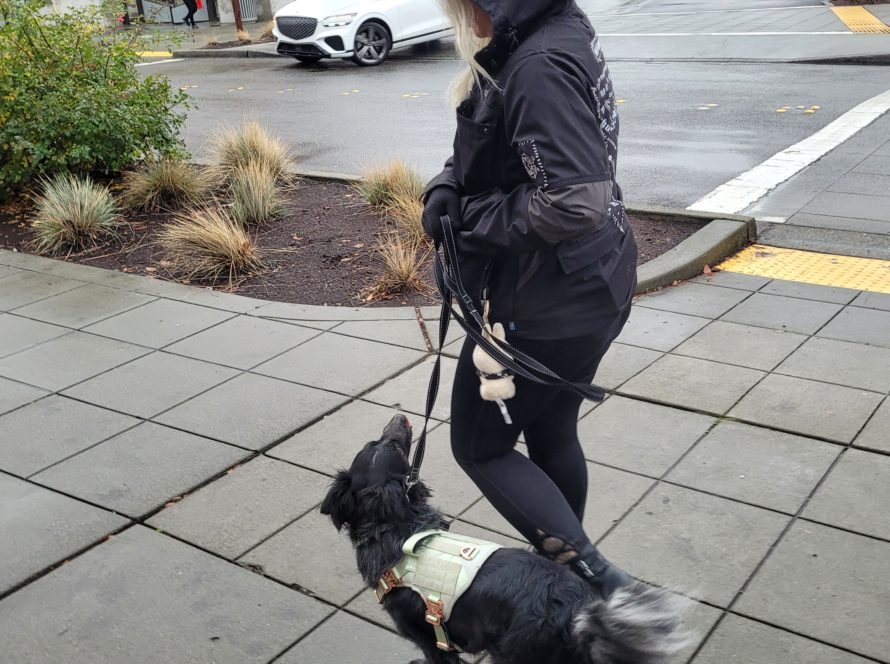
My own service dog, Grimm, is trained to remind me to take my anti-anxiety medication at a certain time of day, provide deep pressure therapy, interrupt hand-picking behaviors, find lost objects (such as my keys and phone), and provide tactile stimulation.
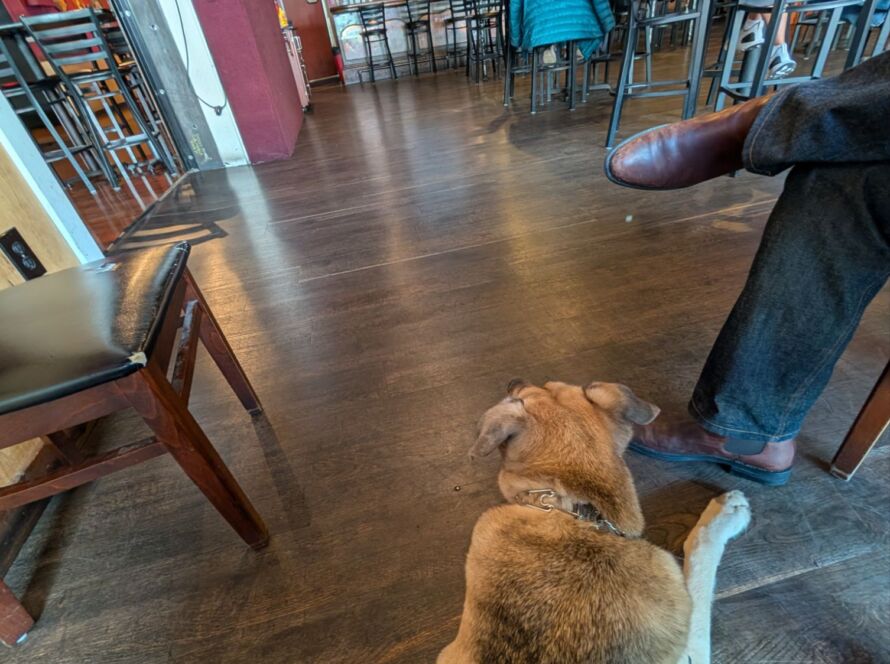
2. Public Access: In addition to being able to consistently perform at least three tasks for a disability, a service dog must be able to accompany their handler anywhere the public is allowed. This requires impeccable obedience, a rock-solid temperament, and the ability to remain calm and non-reactive in environments ranging from a quiet library to a bustling grocery store to even extremely novel places like zoos and theme parks.
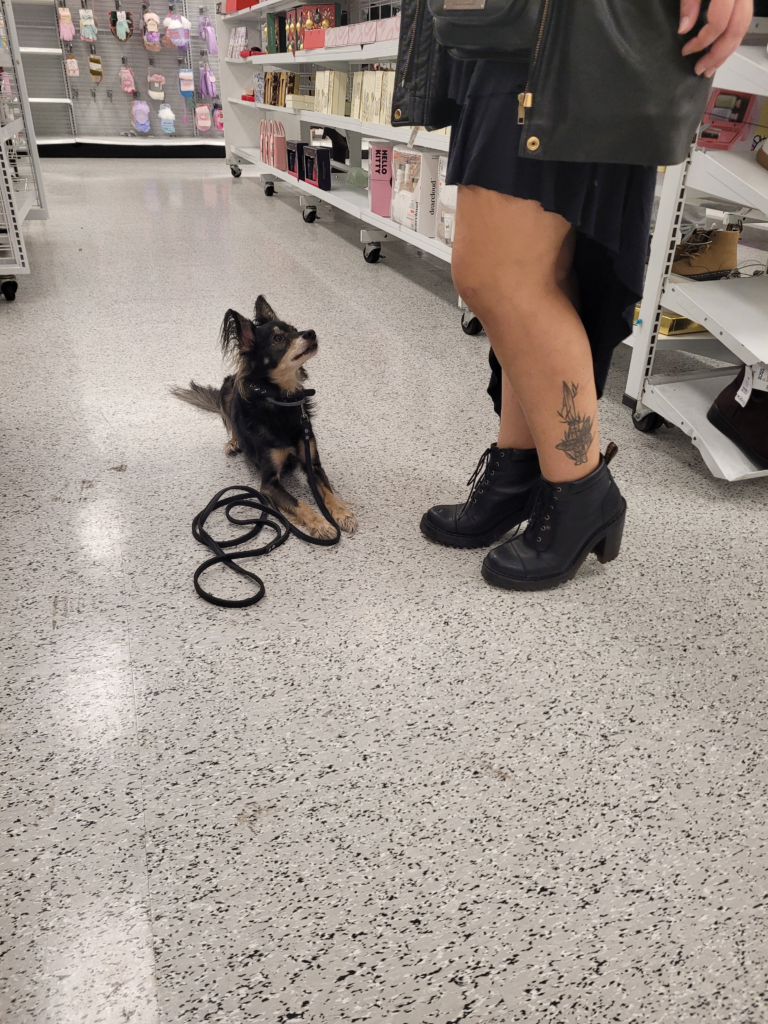

A successful service dog is not just “well-trained”; it is a resilient, stable partner.
The Xoloitzcuintli Temperament: Strengths for Service Work
When we assess a breed for service potential, we look for core traits that align with the job’s demands. The Xolo possesses several remarkable strengths.
Calm and Observant Nature: Unlike high-drive herding breeds, a mature Xolo is often a “velcro dog” in the best sense—deeply attuned to their handler and content to observe quietly. This lower-energy, watchful demeanor is a significant asset in public access, where hyperactivity and impulsive behavior is a major liability.
Intense Handler Bond: Xolos form profound, almost symbiotic relationships with their primary person. I frequently tell people to expect a Xoloitzcuintli to have one favorite person, a small circle of close friends, and a tendency towards apathy to all other people. This handler bond is the foundation of all training. A Xolo is highly socially motivated for you, making them eager to please and exceptionally responsive to their handler’s emotional state.
Intelligence and Problem-Solving Skills: As an ancient, primitive breed, the Xolo is a thinker at its core. They learn quickly, but can also be very independent and challenging to motivate. In the right training framework (which I will cover later in this article), this intelligence allows them to master complex chains of tasks but can also backfire in the area of public access and consistency.
Low-Shedding/Hypoallergenic: The first thing that drew me to the Xolo was the hairless variety’s inability to leave an excessive layer of dog hair on my clothes. For handlers with allergies or who simply prefer a cleaner home, the hairless variety is a significant practical advantage.
The coated variety does shed lightly, but according to standard the coated Xolo its a single-coated dog, making shedding far less than double-coated breeds like shepherds and collies.
The Realities and Challenges: Where Xolos Fall Short as Service Dogs
To provide a realistic perspective, it’s crucial to address the breed-specific challenges that can make or break a Xolo’s service career.
The “Primitive” Temperament: This is the double-edged sword of the Xolo’s intelligence. They are sensitive souls who do not respond well to harsh training or impatience. They can shut down or lean into their stubbornness in unfair situations, and require consistent building and foundational work to establish drive and motivate them to work to a high enough standard for work. A successful Xolo service dog requires a handler who understands balanced training that emphasizes positive reinforcement, clear communication, and respect for the dog’s state of mind.

Environmental Sensitivity (Temperature & Texture): This is arguably the biggest practical hurdle, where many would-be service dogs wash from the training program. While many dogs fail to pass this behavioral hurdle, Xolos especially can struggle with nerves to social environment as well as physical ones.
A hairless Xolo cannot be expected to work outdoors in cold Pacific Northwest (or any other cold weather) winters without reasonable protection. This means a rotating wardrobe of sweaters, coats, and even boots is non-negotiable. Conversely, their bare skin in lighter-colored Xolos can be susceptible to sunburn and overheating in direct sun or on hot pavement.
In addition to temperature, some Xolos can be sensitive to certain textures (e.g., wet grass, metal grates) underfoot, which requires careful conditioning for a dog that must be comfortable anywhere. A service dog is not useful as a medical device if they are not able to function when the grass is wet from dew or rain, or if they refuse to ride up an escalator with their handler.
Size Considerations: The toy and miniature varieties are too small for any form of physical mobility work (bracing, counterbalance). A standard Xolo such as my dog Kola (pictured above) who weighs in at 60lbs may be suitable for some mobility support, like providing momentum for a rise, but this must be cleared by a veterinarian and a professional trainer to prevent injury to the dog.
My Xoloitzcuintli from Amayla Kennels in Hico, Texas, is a sturdy and well-structured animal. However, some Xolos can be off-standard in angulation and end up quite skinny and square. These Xolos and their lean, sometimes delicate build are not suited for heavy pulling or weight-bearing tasks and can be quite fragile in general.
Stranger Aloofness and Reactivity: A landrace of alert and primitive watchdogs, Xolos can be aloof or wary of strangers. Some, like my Kola, can exhibit suspicion of strangers or odd behavior in public, making them entirely unsuitable as service animals. This is not always aggression, but it can manifest as barking, avoidance, or other stress responses in situations that require constant public interaction. Extensive, expert-led socialization and desensitization are critical from puppyhood to have a chance as a successful Xolo service dog.
Task-Specific Evaluation: What Jobs is a Xolo Best Suited For?
Given their profile, Xolos excel in specific service roles and are poorly suited for others.
For example, a well-tempered Xolo can be a helpful Psychiatric Service Dog (PSD): This is arguably the Xolo’s strongest chance at service work. Their innate ability to read their handler’s emotions, combined with their desire for close physical contact, makes them naturals for tasks for PTSD, autism, ADHD, anxiety and panic disorders, and more, such as:
- Deep Pressure Therapy (DPT): Lying across their handler’s lap or chest to provide grounding during an anxiety or panic attack. The hairless variety can uniquely provide skin-to-skin contact, which can provide addition deep soothing.
- Alerting to Rising Anxiety: Noticing subtle cues of distress before a full-blown attack occurs.
- Blocking/Creating Space: Standing in front or behind the handler in a crowd to create a buffer.
- Interrupting Repetitive or Harmful Behaviors: Using a nudge or paw to break a dissociative episode or nail-biting.
Medical Alert & Response: The Xolo’s innate intelligence and strong sense of smell make them capable of being trained to alert to specific medical events, such as oncoming migraines or drops in blood pressure, and then fetching help or medication. Medical alert dogs can be trained to alert for disabilities such as:
- Diabetes
- Anxiety and panic attacks
- Epilepsy
- Migraines
What Tasks Should Xolos Not Do?
While some Xolos may be able to perform some service tasks, they are not meant for every type of work.·
I would not recommend a Xoloitzcuintli for most mobility work, or any task involving bracing, weight-bearing, or pulling a wheelchair. Even for a standard Xolo, I would be concerned about asking mobility work of many Xolos I’ve seen, and feel confidently that they are generally not suitable due to their size and build.
I also would urge against attempting to use a Xolo for guide work for the blind: Their independent nature and environmental sensitivities make them less reliable than traditional guide dog breeds. The Xolo has a tendency to follow their own nose and their own motivations, which makes them an unideal guide dog even with impeccable training.
The Non-Negotiables: Finding and Training a Xolo Service Dog
If you’re committed to the path of a Xolo service dog, here is the framework we recommend.
Do NOT simply buy any Xolo puppy. You must seek an ethically bred puppy from a proven line with successful service dogs. Communicate clearly with the breeder about your service dog goals. A reputable breeder will help you select the puppy from the litter with the most stable, confident, and biddable temperament—not the most shy or reactive one.
Understand that a Xolo is still unideal as a service dog prospect compared to breeds like labs, poodles, and golden retrievers. Even in lines with a few proven service dogs, that does not necessarily mean every dog in that line will be suitable. To my knowledge, there are no reputable Xolo breeders specializing in service dogs. Finding a stable and reliable individual can still be a roll of the dice, even in a wonderful line.
During the critical socialization window from 8 to 16 weeks, your Xolo puppy must be gently and positively exposed to the world. This isn’t just about encounter people and dogs; it’s about experiencing different floors, sounds, smells, and environments they will encounter in public. A misstep here can be difficult to undo, as tiny puppies absorb information and are easily impressed with positive, negative, and neutral experiences.
The right training methodology is also a game changer. As a balanced trainer specializing in behavior modification, I find that Xolos thrive on a foundation of positive reinforcement (marker training with a clicker or “yes” word) to build desire and understanding, with fair, clear boundaries to instill discipline. Purely forceful methods or frequent unfair correction will likely break your Xolo’s spirit and ruin a potential service dog.
Self-Training a Service Dog?
Join my mailing list to be notified of the release of BLACK MAGIC SERVICE DOG TRAINING, my all-encompassing guide to training a service dog from home and building an amazing dog-handler bond.
Public Access Preparation:
This is where many owner-trainers struggle. You must systematically proof your Xolo’s obedience amidst distractions. I recommend a structured program that builds from your living room, to your yard, to a quiet park, to a pet-friendly store, and finally to a non-pet-friendly environment.
Some levels of nerve can be worked through and trained. But at a certain point, it’s important to understand when requesting service work of a dog (Xolo or not) is unfair and unkind to the dog. An incredibly nervy dog needs help navigating the world for their own anxiety, and many Xolos fall in the realm of incompatibility with assisting a human with their own needs.
Conclusion: A Demanding but Rewarding Partnership
So, can a Xolo be a service dog? Technically yes, but with critical caveats.
A stable Xoloitzcuintli can be an exceptional psychiatric or medical alert service dog for a handler who understands and appreciates the primitive canine mind and is willing to put in just a much work on their part. This patient partnership demands a significant investment in specialized socialization, environmental awareness, and gentle-but-firm training. It is not the easiest path, but for the right person, the reward is a service dog that is not just a medical tool, but a soul-deep companion.
Your Next Steps: Here to Help
The journey from Xolo prospect to a certified service dog team is complex. You don’t have to navigate it alone. If you are considering a Xolo as a service dog, my Prospect Evaluation Service can help you assess a potential puppy or adult dog for service suitability (regardless of breed).
If you already have a Xolo, my Service Dog Training Programs, from foundational obedience to advanced public access and task training, can easily be tailored to the unique needs of primitive and sensitive breeds given my experience building a Xolo into a reliable working dog.
Contact Black Magic Dog Training in Kent, WA today for a consultation. Together, we will honestly evaluate your goals and build a realistic, successful plan for your self-training service dog partnership.