T
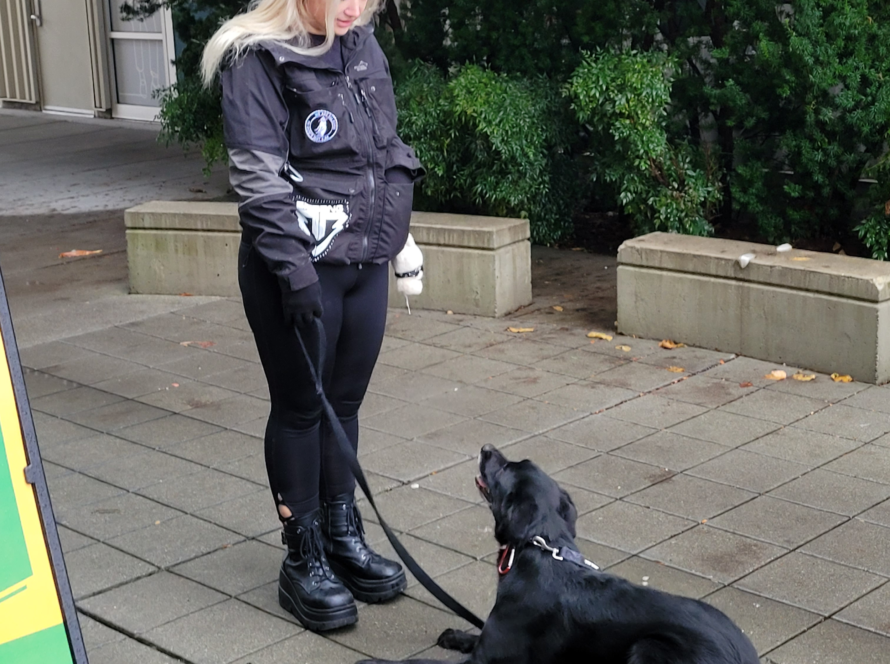
At Black Magic Dog Training, I view service dog training not as a single event, but as a sacred journey with distinct, non-negotiable phases. Each stage builds upon the last, forging not just a trained animal, but a resilient, thinking partner. This guide will walk you through the five key stages of this journey, providing a realistic roadmap from the first spark of potential to the final, seamless integration of a working service dog into your life.
The Prospect Evaluation
Goal: To determine, with clear-eyed objectivity, if the raw material of the dog is suitable for the demanding work ahead.
This is the most critical stage, and the one most often rushed. It is far more than a basic temperament test. A full prospect evaluation is a deep dive into the dog’s genetic and psychological blueprint. We are not just asking, “Is this a good dog?” We are asking, “Can this dog’s specific mind and body handle the immense pressure of service work?”
Key Activities in This Stage:
- Nerve and Environmental Stability Testing: Exposing the dog to novel, sudden, and loud stimuli in a controlled manner to assess confidence and recovery time.
- Drive and Motivation Assessment: Evaluating the dog’s prey drive (for retrieval work), pack drive (for bonding), and food motivation to understand what “currency” will fuel their training.
- Health and Structural Screening: A veterinary check-up, analysis of health within the dog’s pedigree (if available) and often preliminary x-rays to rule out underlying conditions or risks like hip dysplasia that would end a career prematurely.
- Biddability and Problem-Solving Analysis: Observing how the dog responds to gentle pressure, how it handles frustration, and whether it looks to humans for solutions.
The Black Magic Verdict: This stage ends with a clear “go/no-go” decision. A “wash” or “career change” at this point is not a failure; it is a success of the evaluation process, preventing heartache and ensuring the dog finds a suitable role where it can thrive. Proceeding with a marginal candidate is the gravest error one can make.
The Foundational Framework
Goal: To build unwavering focus, engagement, and basic obedience that will form the bedrock for all advanced work.
With a confirmed prospect, we begin constructing the foundation. This stage is not about teaching “sit” and “down” as commands for the sake of it. It is about forging these behaviors into reflexive, reliable tools that function as the dog’s default setting, even amidst distraction. The primary student in this stage is often the handler, learning the precise mechanics of timing, marker training, and clear communication.
Key Activities in This Stage:
- Marker Training Mastery: Impeccably pairing a “Yes!” or clicker with rewards until the sound itself becomes a powerful reinforcer.
- The Engagement Ritual: Systematically teaching the dog that the handler is the most valuable source of information and reward in any environment. This includes building a powerful automatic “check-in.”
- Core Obedience with Precision: Teaching sit, down, stay, and heel not as requests, but as expectations, with speed, enthusiasm, and precision.
- Impulse Control Foundation: Installing a flawless “leave it,” “wait,” and the ability to settle calmly amidst mild distractions.
- Socialization & Neutrality: Carefully exposing the dog to a wide variety of people, sounds, and surfaces to build a neutral, confident worldview.
The Black Magic Verdict: We do not move to Stage 3 until the dog’s obedience is 90% reliable in a low-distraction environment like the home. A weak foundation will crack under the pressure of advanced training.
Task Training & Public Access
Goal: To teach the dog its disability-mitigating tasks and to proof its foundational obedience in public spaces.
This is not a linear stage, but two parallel tracks that run simultaneously. Task training often happens in the quiet of the home, while public access training happens out in the world. The skills developed in one track support the other.
Task Training
This is the “what” of the service dog’s job. We break down complex tasks into their smallest components and use shaping and capturing to build them.
Examples: Retrieving specific items, providing Deep Pressure Therapy (DPT), alerting to a medical event, interrupting dissociative episodes, turning on lights.
The Process: We use high-value rewards and the marker to teach the task itself, then add duration, distance, and distraction to the task, just as we do with obedience.
Public Access Proofing
This is the “where.” We take the flawless obedience from Stage 2 and systematically challenge it using the Three D’s:
Duration: Can the dog hold a “down-stay” for 30 minutes?
Distance: Can the dog perform a “stay” while you are 50 feet away?
Distraction: Can the dog heel perfectly in a pet-friendly store, then in a quiet hardware store, and finally on a busy sidewalk?
The Black Magic Verdict: The dog learns that its tasks and its obedience are not context-specific. A “retrieve” must work in the living room and the library. A “heel” must be perfect on a trail and in a crowded mall.
Integration & Generalization – Weaving the Tapestry
Goal: To seamlessly weave task work and public access obedience into a single, fluid performance in any real-world scenario.
This is where the separate threads of training are woven into a strong, unbreakable rope. The dog learns to toggle instantly between its different roles: working, settling, and tasking, all while maintaining its public access manners. This stage is the ultimate test of the foundation built in the previous stages.
Key Activities in This Stage:
- Tasking in Public: Asking the dog to perform its medical alert or retrieval task while in a distracting environment like a grocery store.
- The “Off-Switch”: Proofing the “settle” command in increasingly challenging locations, such as a café patio or a doctor’s waiting room, for extended periods.
- Environmental Endurance: Building the dog’s stamina and focus for full-day public outings, simulating the reality of being a working partner.
- Handler Error Drills: Preparing for real-world handler mistakes, like accidental leash drops or unclear cues, and ensuring the dog makes safe, intelligent choices.
The Black Magic Verdict: This stage ends when the handler can confidently navigate a complex, multi-stop public outing with their dog performing all necessary tasks and maintaining impeccable manners without constant management. The team operates as a single, coordinated unit.
The Working Partnership
Goal: The full integration of the service dog into the handler’s life, with an emphasis on maintenance, problem-solving, and the deepening of an unspoken bond.
Graduation is not the end of training; it is the beginning of the working partnership. A service dog is a living, breathing being, not a programmed machine. This final, ongoing stage is about maintaining the skills, adapting to the handler’s evolving needs, and nurturing the profound connection that makes the team more than the sum of its parts.
Key Activities in This Stage:
- Ongoing Maintenance Training: Short, daily reinforcement of core skills and tasks to prevent “skill drift.”
- Public Access Etiquette: The handler becomes a subtle, confident team leader, advocating for their dog’s space and rights without confrontation.
- Problem-Solving New Challenges: As the handler’s life changes, new tasks or environmental challenges may arise. The solid foundation allows for the training of new skills as needed.
- Vigilant Health & Wellness: A proactive approach to the dog’s physical and mental health to ensure a long, sustainable career.
The path from prospect to partner is a marathon, not a sprint. It demands patience, immense dedication, and a willingness to follow a structured process without cutting corners. Each of the five stages is a sacred space for growth, for both the dog and the handler.
By honoring this architecture, you do not just create a tool. You build a legacy of trust, independence, and a partnership that will stand as one of the most meaningful relationships of your life. The destination is worth every step of the journey.
Ready to Begin Your Journey with a Master Guide?
Navigating the five stages of service dog training alone is a daunting task. The guidance of a professional who has walked this path before can help you avoid costly mistakes, train with greater efficiency, and build a more resilient partnership.
At Black Magic Dog Training, we are not just trainers; we are architects of life-changing partnerships.
Service Dog Consultation: I will evaluate your prospect, help you choose a dog, assess your current stage, identify gaps in your training, and build a customized, stage-by-stage plan for your team. All depending on your needs.
Handler Advocacy & Education: I always endeavor to empower you with the knowledge and confidence to be the leader your service dog needs, both during training and throughout your working partnership.
Don’t navigate this complex journey alone. Let me provide the map, the tools, and the expert guidance. Contact Black Magic Dog Training today to schedule your consultation and take the first, confident step toward a powerful partnership.