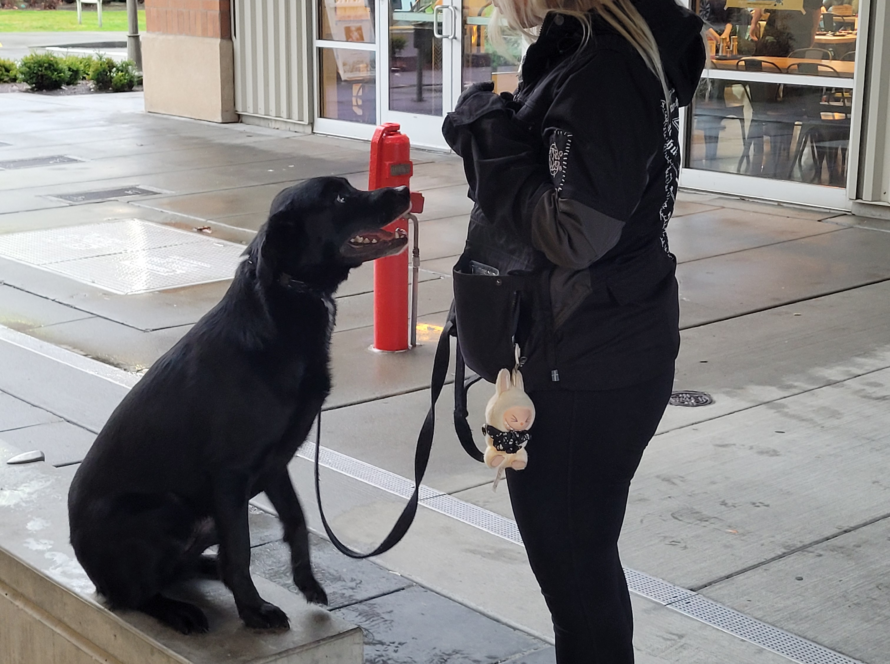
Inthe world of dog training, few tools are as deceptively simple yet profoundly powerful as the marker. A sharp “Yes!” or the precise snap of a clicker seems almost too basic to be effective. How can a sound, devoid of any inherent meaning, hold the key to teaching complex behaviors, building unwavering focus, and forging a deep mental partnership with a dog?
When I was an “dog behavior intern” at an animal shelter, the (unfortunately lackluster) in-house trainer once told me that there was a psychologic component to the sound of a clicker that made it rewarding. This sort of misinformation is what has a lot of dog owners today confused about clicker training and about positive reinforcement in general.
The magic of positive markers lie not in the inherent sound itself, but in the psychological alchemy it performs. At its core, marker training is not about bribing a dog with treats. It is about creating a shared language. It is the art of capturing a moment in time and infusing it with meaning, transforming random behavior into intentional action.
At Black Magic Dog Training, I view marker training not as a standalone method, but as the fundamental bedrock of all communication. It is one of the first things dogs start learning when working with me.
This article is a deep dive into the psychology behind this tool, moving beyond the basic “click and treat” to explore how a true understanding of reinforcement can unlock your dog’s mind and transform you from a commander of actions into a shaper of understanding.
The Basics of Classical vs. Operant Conditioning
To wield a marker with power, you must first understand the two psychological forces you are harnessing. They are the twin engines of all learning.
Classical Conditioning: The “Feeling” of the Marker
This is the process made famous by Pavlov’s dogs, where a neutral stimulus (such as the sound of a bell) is paired with a meaningful one (the anticipation of food) until the neutral stimulus alone elicits the response (salivation).
The Marker’s First Job: Before it can be used to train behaviors, the marker must be “charged.” We do this by repeatedly pairing the sound—”Click!” or “Yes!”—with the immediate delivery of a high-value treat. Many dog trainers set aside full sessions just for charging a clicker or other marker, but I prefer to work it into an easy training session, marking and rewarding for repetitions of behaviors a dog already knows. Both are valid options, but I prefer to the dog to learn the context of the marker in offering behavior.
The Psychological Shift: During the charging process, the dog’s brain undergoes a fundamental rewiring. The click is no longer a meaningless noise; it becomes a Conditioned Reinforcer. It transforms into a promise, an event marker that tells the dog, “What you are doing right now is correct, and a reward is coming.” This sound now carries the same emotional weight as the treat itself—it triggers a surge of dopamine, the neurotransmitter associated with pleasure and anticipation.
Operant Conditioning: The “Action” of the Marker
This is the process of learning through consequences, formalized by B.F. Skinner. Behaviors that are reinforced become more likely to be repeated.
The Marker’s Second Job: Once charged, the marker is used to “operate” on the dog’s behavior. It pinpoints the exact moment a desired action occurs and bridges the tiny gap in time between the action and the delivery of the primary reward (the treat).
The Precision of the Pinpoint: This is the true magic. Without a marker, if you ask for a “sit” and your dog complies, there is a delay as you get the treat from your pouch, or even in the time it takes from going from your hand to your dog’s mouth. In that delay, the dog might scratch its ear or look away. What, exactly, are you rewarding? The marker eliminates this ambiguity.
Click! The instant the dog’s rear touches the floor. The message is crystal clear.
When combined, these two forces create an unstoppable learning machine. The marker becomes a “yes” that feels as good as the treat itself, delivered with the precision of a surgeon’s scalpel.
The Layers of Marker Training
Once you grasp the fundamentals, you can begin to manipulate these psychological principles to achieve advanced training goals.
Value: What Makes a Reinforcer “Reinforcing”?
A reinforcer is not whatyou think is valuable; it’s what the dog is willing to work for at that moment.
Primary Reinforcers: These are biological necessities—food, water, freedom.
Secondary Reinforcers: These are learned (like the marker, or praise).
Life Reinforcers: These are the most powerful and often overlooked. Access to the environment is the ultimate currency. Throwing a ball, opening a door for a sniff, or releasing to go greet a friend can be far more motivating than any treat.
In my private lessons in the greater Seattle-Tacoma area, I teach handlers to use the Premack Principle (or “Grandma’s Law”: first do what I want, then you get to do what you want). The marker bridges the two. For example: “Touch my hand” -> Click! -> “Get to go sniff that bush.” You have just used the environment itself as your primary reward.
Shaping: Building Complex Behaviors from Nothing
Shaping is the process of reinforcing successive approximations toward a final, complex behavior. It is how you teach a dog to turn off a light switch, retrieve a specific item, or perform an intricate trick without forcing or luring them.
The Process: You start by reinforcing any tiny movement in the right direction. To teach “spin,” you might first click for a head turn. Then you raise the criteria: you wait for a head turn and a shoulder shift. Then for a full step. You are using the marker to guide the dog, like a sculptor chiseling a statue from a block of marble.
The Psychological Impact: Shaping teaches a dog to offer behaviors and to problem-solve. It engages their cognitive mind, creating an active, thinking partner rather than a passive, command-following robot. It builds immense confidence and creativity.
The Power of Variable Reinforcement Schedules: The “Slot Machine” Effect
This is one of the most potent psychological tools available.Once a behavior is learned, switching from a continuous reinforcement schedule (rewarding every single time) to a variable schedule (rewarding unpredictably) makes the behavior incredibly persistent and resistant to extinction.
This is the same principle that makes slot machines addictive.
The “maybe” of a big payoff is more compelling than a guaranteed, small one.
The dog works harder and longer, hoping this is the time the click and jackpot will come.
For a flawless recall, for example, you might stop rewarding with a treat every single time. Instead, you reward with a jackpot (a handful of treats, a game of tug) on a random schedule. The dog never knows if this recall will yield the biggest reward of the day, so they are motivated to perform it perfectly every time.
Integrating Markers with Clarity
As a practitioner of fair balanced training, my philosophy at Black Magic Dog Training is that communication must be a complete conversation. This means having a word for “yes” and a word for “no.”
The “No Reward Marker” (NRM) – The Informational “Oops!”
An NRM is a sound that provides clear information that a choice was incorrect, without emotion or punishment. It is the calm, neutral counterpart to the energized “Yes!”
It tells the dog, “That action is not what I’m looking for. Try something else.” It prevents the dog from practicing the wrong behavior and wasting time.
For an intelligent, problem-solving animal, (especially my primitive, independent-minded Xolos) a lack of information is frustrating. The NRM provides the missing piece of the puzzle. It’s like a game of “hot and cold”—the “Yes!” is “hot,” the “Oops” is “cold.” This clarity is especially valued by independent, primitive breeds who need to understand the utility of an action.
When used together, the reinforcing marker and the NRM create a rich, binary language that allows you to guide your dog with immense precision, reducing frustration on both ends of the leash and accelerating the learning process.
The Corrective Marker
Similar to the NRM is the actual “No.” This is the stark opposite of our reward/reinforcement marker, and is meant to communicate firmly but fairly, “this behavior is not acceptable.”
Conditioning your corrective marker involves a similar process to charging your clicker or “yes!” but instead involves an undesirable consequence for the dog, such as a gentle pop on the leash or the removal of a desired reward. This conditions the dog to see the word “no” as a predictor of a consequence (and, as per balanced training, also a predictor of an opportunity for reward!) and therefore provides the much-needed meaning to the sound.
Pairing and “charging” your corrective marker is often the difference between a “no” that your dog respects and a “no” your dog ignores as just a random noise.
Where Marker Training Goes Wrong
Even the most powerful magic can be misapplied. Here are the common pitfalls.
The Uncharged Marker: Using the click or “yes” without first building its value. The sound is meaningless, and the training fails.
The “Burnt” Marker: Clicking and then failing to deliver a reward, or delivering a low-value one. This breaks the promise and devalues your most important tool.
Poor Timing: Clicking a half-second too late, reinforcing the wrong part of the behavior chain (e.g., clicking as the dog stands up from a sit, not as it sits down).
The “Cookie Dispenser” Effect: The handler becomes a vending machine. The dog works for the food, not for the partnership. This is why I integrate life rewards and play so heavily in my own dog training practice.
Lack of Fading: Continuing to use the marker for a behavior that is already known and on a variable schedule. The marker should eventually be phased out for fluent behaviors, becoming a occasional “bonus” rather than a constant crutch.
Mastering the psychology of reinforcement elevates you from a mere trainer to a true communicator. The marker is not just a tool for teaching “sit” and “stay.” It is the key to a dialogue. It allows you to capture moments of brilliance, shape complex ideas, and build a shared understanding that transcends simple command-and-response.
When you truly understand this, you stop seeing your dog as a creature to be commanded and start seeing them as a partner with a mind eager to engage, to solve puzzles, and to collaborate. You are no longer just giving orders; you are having a conversation. And in that conversation, you will discover a level of bonding and mutual respect that is the truest form of canine magic.
Stop just giving commands and start having a conversation. Contact Black Magic Dog Training today to unlock the psychological secrets of a powerful partnership with your dog.