Disclaimer: this article may contain affiliate links, and I may receive a commission on sales when you use those links, at no additional cost to you. I only recommend products I use and genuinely love.
It’s Not Stubbornness, It’s Intelligence
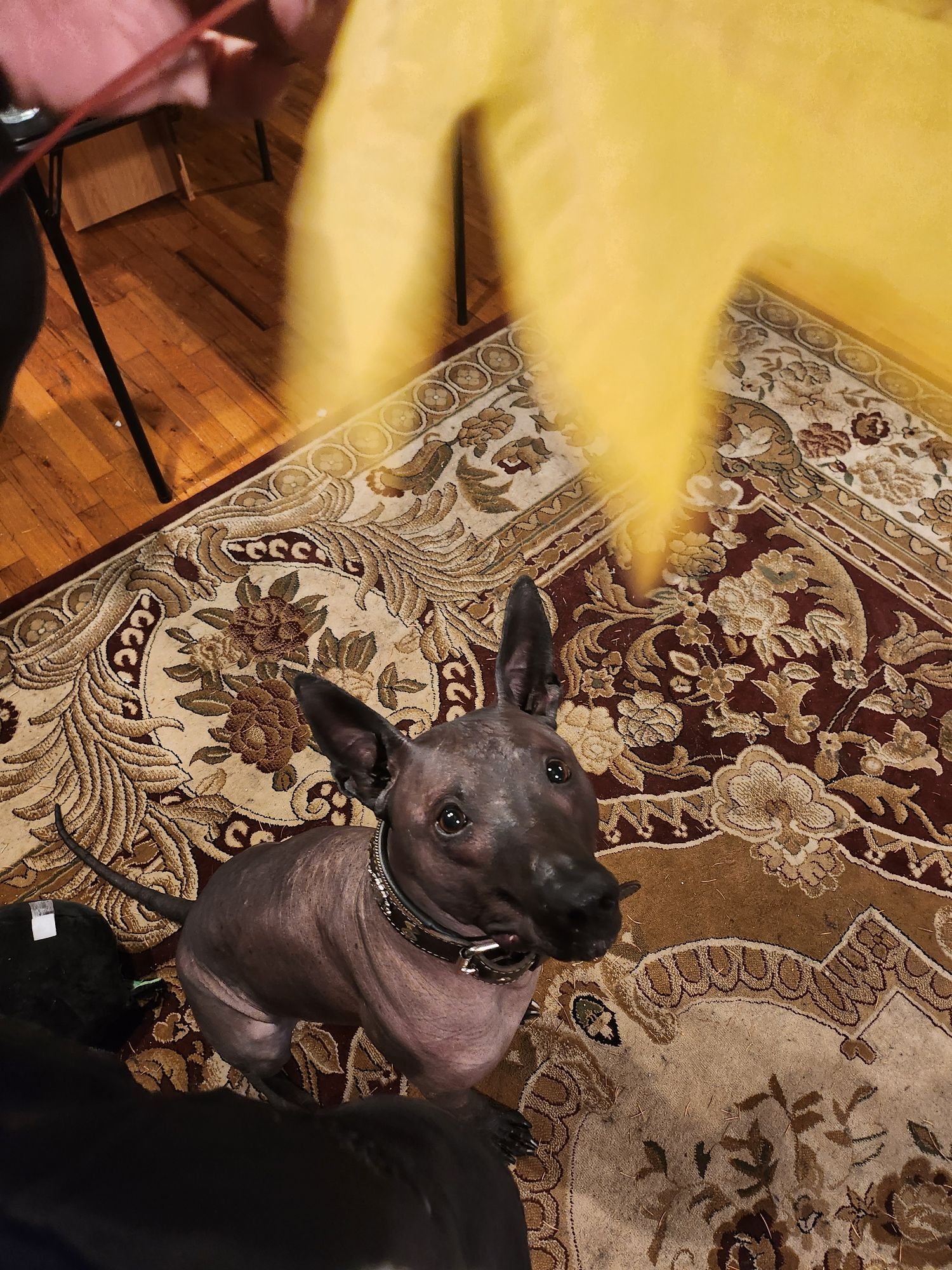
You’ve taught the “sit” command. Your Xolo looks you dead in the eye, seemingly understanding perfectly, and then decides to follow an interesting scent on the ground, as if your request was hardly even a passing thought. You bring out a high-value treat. They might deign to comply, or they might simply walk off, leaving you feeling frustrated and labeling your hairless dog as “stubborn.”
If this scenario is familiar, it’s time for a paradigm shift. What you are witnessing is not deliberate defiance. It is the manifestation of a primitive, problem-solving intelligence.
The Xolo is a landrace breed. Unlike your herding breeds and bird dogs of old, the Xolo was developed to think for itself, to make judgments, and to act independently of human direction. In the modern training context, this means they constantly perform a cost-benefit analysis: in essence, “What’s in it for me?”
Training a Xolo isn’t about barking commands; it’s about orchestrating collaboration. In this comprehensive guide, we will move beyond basic obedience and delve into the psychology of the independent Xolo. And hopefully, I will equip you with advanced motivation techniques to transform your “stubborn” dog into a willing, enthusiastic partner, deepening your bond in ways you never thought possible.
Understanding the Xolo Mind: The CEO, Not the Employee
To motivate an independent thinker, you must first understand what drives them. Forget the model of the biddable Border Collie, eager to please for a plain piece of kibble. The Xolo is a little more astute than that, and operates on an entirely different wavelength.
Key Traits of the “Thinking” Dog:
- Low Biddability, High Intelligence: They learn commands with astonishing speed but have a low innate desire to simply obey for the sake of obedience. The utility of the action must be clear to them.
- A Rich Inner World: Their drives are often subtler than a retrieving breed’s. They are driven by curiosity, the pursuit of comfort, the desire for control over their environment, and the quality of their social bond.
- Sensitivity to Pressure: As a sensitive, primitive breed, they are hyper-aware of their handler’s energy. Frustration, impatience, or heavy-handed corrections will cause them to disengage entirely, shutting down the learning process. Fairness and clarity are non-negotiable.
In essence, you are not training a subordinate; you are negotiating with a savvy, four-legged CEO. Your job is to present a business proposal so compelling they can’t refuse.
The Motivational Toolkit: Moving Beyond Basic Treats
Relying solely on basic food rewards is the most common mistake made with independent breeds. If you want to achieve high-level training with a dog like a Xolo, it’s critical to build a diverse arsenal of motivators for every possible situation.
The Power of the Premack Principle
The Premack Principle states that a more probable behavior can be used to reinforce a less probable one. In simple terms: “First do what I want, because it helps you get to do what you want.” This is catnip for the Xolo mind, as it gives them agency.
In Practice:
- “Sit” at the door (low probability) is reinforced by getting to go outside and explore (high probability).
- “Come” away from a interesting smell (low probability) is reinforced by getting a release command to go back and investigate it (high probability).
- A formal “heel” for a few steps (low probability) is reinforced by a release to go sniff freely on a long leash (high probability).
The Art of the Reward Swap
Everyday life is filled with rewards. Things like couch time, accessing toys, and getting to go out the door are all charged with built-in motivation. To train a “stubborn” dog, it’s important to stop viewing these moments as givens, and start viewing them as currency.
What are Life Rewards?
A life reward is what dog trainers like myself typically call non-standard rewards built in to day-to-day life. While we can control and micro-manage things like training treats and play time, we can also control our environment so that every enjoyable thing can be leverages. In essence, a life reward is anything your dog wants at that moment.
Life rewards could be:
- The thrown ball.
- Permission to jump on the sofa.
- The door opening or leash going on for a walk.
- Your attention and petting.
Before granting access to the life reward, ask for a simple behavior.
You want up on the sofa? “Sit.”
You want me to throw the ball? “Place.”
You want to go through the door? A calm “Down.”
This teaches the Xolo that compliance with you is the key to unlocking all the good things in their world.
Play & Possession
For many Xolos, a game of tug is far more valuable than a piece of chicken. I’ve found Xolos to be a generally high prey drive breed, though it can manifest in more “primitive” ways than in dogs like German Shepherds and Border Collies.
It’s play with you that builds engagement and channels their energy into a collaborative, rather than independent, activity.
Finding the Right Toy
When it comes to finding your Xolo’s drive for play as a reward, the best thing you can do is experiment. Does your Xolo prefer a fluffy tug, a jute braid, or a squeaky toy?
Building Tug Drive: If your Xolo is anything like my Kola, play may need a little building to come out in full-force. When I first brought Kola home, he had no interest in playing tug. Now, he sees a tug and goes absolutely wild. When building, keep sessions short and hyper-enthusiastic. Let them “win” often to build confidence and value. Use the toy as a reward for a swift “come” or a sharp “sit.”
The “Out” Command: A reliable “out” or at least a “switch” to a new toy is critical. This is where balanced training shines—using fair pressure and the premack reward of more tug to teach the release ensures the game remains structured and safe.
Partnership, The Ultimate Reward
For a velcro breed like the Xoloitzcuintli, your focused attention and praise can become a powerful motivator—but it must be earned. By being the source of all good things (food, play, freedom, affection) and a calm, confident leader, you position yourself as the most valuable resource in your Xolo’s life.
Over time, the finest reward for your stubborn, primitive dog becomes the privilege of working with you.
A Balanced Methodology: Why Clarity is Kindness
Many owners of independent breeds are told to use “positive-only” methods. While positive reinforcement is the absolute cornerstone of building new behavior, the Xolo’s intelligence often demands more information. This is where a balanced training philosophy like the one I employ at Black Magic Dog Training is not just effective, but essential for clarity.
The Two Sides of Communication
Positive Reinforcement (Mark & Reward): This tells the dog “Yes! That is exactly what I want!” I always use a marker (a clicker or a distinct “yes!”) to pinpoint the correct behavior, followed by a high-value reward. This is how you build desire and understanding for new behaviors.
Fair Pressure & Release: This provides the Xolo (or any dog!) with necessary information about what we don’t want. It is not about creating discomfort; it is about providing feedback and information, and creating a fair consequence for ignoring a known command.
For example, asking for a “sit” with a light upward leash pressure. The moment the dog sits, the pressure is released and a reward is given. The dog learns that pressure is not scary; it is simply a cue that can be easily turned off through compliance.
I have found these types of methods to especially work well for primitive breeds and the Xolotizcuintli because it appeals to their problem-solving mind.
The dog thinks, “how do I make this mildly annoying sensation go away? Ah, by sitting. Excellent, I even get a treat at the end.” It provides the clarity and boundaries that a primitive, independent mind inherently respects.
Without this balance, you risk creating a dog that only works when the treats are visible—a “fair-weather friend” rather than a reliable partner.
Advanced Techniques for the Thinking Dog
Once you have the foundational mindset and tools, you can implement these advanced strategies.
Keep Sessions Short and Sweet (“Quit on a High”)
The Xolo mind bores easily. Three to five-minute training sessions are far more effective than one fifteen-minute slog. Always endeavor to end the session after a success, with your dog wanting more. This leaves them excited for the next session and builds drive for the activity.
Embrace Variable Reinforcement Schedules
Once a behavior is learned, switch from rewarding every time (continuous reinforcement) to rewarding unpredictably (variable reinforcement). This is the same principle that makes slot machines so addictive. The “maybe” of a big payoff keeps the Xolo engaged and working hard, long after the treats have left your pocket.
Train in the 3 D’s: Distance, Duration, Distraction
Independence often shows up when you add challenges. Be systematic in your approach to proofing trained behaviors with your Xolo.
- Duration: Ask for a longer “down-stay” over time. As you work on duration, expect to reward more consistently, as if you are training the behavior new.
- Distance: Take a step back from your already-practiced “sit-stay.” Expect your proximity change to impact your dog’s ability to hold their command, and reward for shorter durations.
- Distraction: Practice “recall” in the backyard, then at a quiet park, then in a slightly busier environment. Pro Tip: Lower your criteria when you raise the distraction. A “come” in a new place is a huge win, even if it’s not perfect.
Channel Independence into a “Job”
When training an independent but intelligent dog, give their intelligent mind a constructive outlet.
Nosework: This is a perfect fit. It taps into their primal instincts and allows them to problem-solve independently, but within a framework you control.
AKC Trick Dog: The variety and creativity of trick training are often more engaging than repetitive obedience. Contact Black Magic Dog Training for online and in-person (Kent Wa) Trick Dog Classes!
Canine Fitness: Using foot targets, balance pods, cavaletti rails, and platforms turns exercise into a mental puzzle. Going for the FitDog AKC title? Contact me at Black Magic Dog Training today to sign up for an online FitDog group class, valid towards the titles Fitdog Bronze, Fitdog Silver, and Fitdog Gold.
Troubleshooting Common Roadblocks
“My Xolo just walks away from me during training!”
Diagnosis: The value of the reward or the activity is too low. The task is too hard or boring.
Solution: Raise the value of your rewards (try real meat, cheese, or a favorite toy). Make the game more fun, add energy, and temporarily lower your criteria. End the session immediately if they walk away—don’t plead.
“He knows it inside, but completely ignores me outside!”
Diagnosis: This is classic. The environment is distracting, and possibly more rewarding than you are.
Solution: Don’t jump to the dog park. Go back to step one. Practice in your garage, then your driveway, then a completely empty parking lot. Use a long-line leash for safety and a high-value reward schedule.
“He only listens when he knows I have food.”
Diagnosis: An over-reliance on food lures and a lack of variable reinforcement and life rewards.
Solution: Start phasing out the food lure quickly. Use a hand signal. Start rewarding with play, praise, or permission to do something fun. Implement a variable schedule of reinforcement.
From Independent Spirit to Willing Partner
Training a Xoloitzcuintli is a journey in humility, patience, and profound connection. It requires you to be a more thoughtful, engaging, and clear communicator. When you stop fighting their independence and start speaking the language of a collaborative partnership, you will unlock a level of loyalty and willingness that is unique to this ancient breed.
The goal is not to break their spirit, but to channel it. It is to show them that the most rewarding path, the most interesting puzzles, and the most fulfilling freedom are found not in acting alone, but in walking willingly by your side.
What now? Stop the struggle. Start the partnership.
The techniques in this article are a foundation, but every Xolo is an individual. If you’re feeling frustrated or want to accelerate your journey, professional guidance tailored to primitive breeds is the key.
At Black Magic Dog Training in Kent, WA, I specialize in translating the unique language of the thinking dog. Your Xolo is waiting for a leader worth following. Let me help you become that person.
Contact me today to schedule your free training assessment and transform your relationship with your ancient companion.