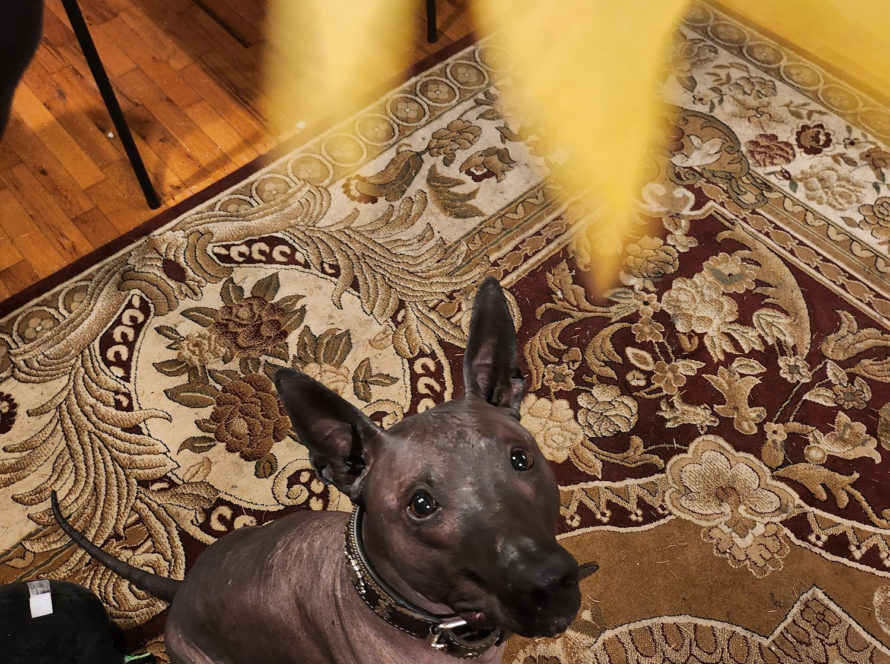
Everymaster of an art has a library. Its shelves are not filled with perfect, unblemished volumes, but with dog-eared, note-riddled, coffee-stained pages—each one a testament to a lesson learned, a paradigm shifted, or a theory tested in the crucible of real-world experience. Over the last ten year, my journey as a balanced trainer at Black Magic Dog Training in Kent, WA has been guided by these voices from the page.
I love learning dog training from books. It’s like receiving a glimpse inside the heads of your favorite and most accomplished trainers.
But no single book, no matter how brilliant, holds the entire truth. The path to mastery is made of fragments of wisdom, collected and made into a personal philosophy. Today, I’m opening my library to you. These are the five books that left an indelible mark on my methods. And I will reveal the crucial gaps between their pages that ultimately compelled me to pick up my own pen and write.
The Other End of the Leash by Patricia B. McConnell
Humans and dogs are two different species trying to communicate, and we are often terrible at it. This book is a masterclass in understanding how our human primate instincts (hugging, staring, using a high-pitched “happy” voice) are often misinterpreted by our canine companions.
McConnell, an ethologist, doesn’t just teach you what to do; she explains why it works from a biological and evolutionary perspective. It’s the foundational text for developing empathy and seeing the world from your dog’s point of view. It teaches you to read the subtle energy you project, making it a perfect primer for the work I do at Black Magic Dog Training.
This book is more of the the “why” behind the “what.” It’s the first book (at least, of books not authored by myself!) I recommend to any new client because it transforms owners from commanders into communicators.
Behavior Adjustment Training 2.0 by Grisha Stewart
Learning that reactivity and fear are not acts of defiance but emotional problems requiring an emotional solution is one of the hardest things to teach clients. BAT 2.0 provides a structured, systematic framework for rehabilitating reactive dogs using functional rewards and controlled exposure.
For anyone dealing with leash reactivity, fear, or aggression, this is the bible. It provides a clear, step-by-step ritual for changing a dog’s emotional response to triggers. It teaches the handler to become a safe harbor and a guide, not just a leash-holder.
As a balanced trainer who incorporates correction even into reactivity training, I still feel this is the most powerful behavior modification protocol I’ve encountered in a physical book. It aligns perfectly with, and has helped build, my philosophy of addressing the root emotion, not just suppressing the symptom. It’s a complex, potent spell that requires a skilled hand to cast effectively.
No Bad Dogs by Barbara Woodhouse
The reality of dog training is simple, provided you are infinitely patient, utterly consistent, and project a calm, unshakable authority. Woodhouse, a television personality from the 80s, championed the power of tone, body language, and the “walkies” as the ultimate reward.
While some of her methods are dated, her core philosophy of leadership is timeless. She understood the canine need for a confident guide and leader long before it was a common concept. Her emphasis on the joy of training and the importance of the daily walk is a potent reminder that fundamentals never go out of style.
Woodhouse provides the “backbone.” She reminds us that all the modern science in the world is useless without the calm, assertive energy that makes a dog want to follow you.
Stopping Leash Reactivity by Ted Efthymiadis
Leash reactivity is a solvable training problem that often requires a balanced approach, incorporating clear consequences for poor choices alongside reinforcement for good ones.
This is a no-nonsense, practical field guide. Where BAT 2.0 is heavy on theory and structure, Efthymiadis provides a straightforward, actionable playbook. He tackles the issue from a training perspective, giving handlers immediate tools to manage and correct the behavior while working on the underlying emotion.
This book is the “how-to” for the handler in the trenches. It acknowledges that while we work on the “why” (fear/frustration), we also need to be able to handle our dogs safely today. It deeply validates the balanced approach I myself use every day, without undermining the dedication to compassion that is necessary for long-term behavioral wellness.
Train Your Dog Like a Pro by Jean Donaldson
At the end of the day, dog training is a mechanical skillset based on the scientific principles of learning theory. Precision, timing, and consistency are everything. Your dog needs appropriate progression, fair communication, and leverage of clear motivators.
Donaldson breaks down training into a clean, logical process. She is the ultimate advocate for the dog, arguing that failures in training are almost always failures of the human’s mechanics, not the dog’s intellect or willingness. This book will sharpen your technical skills like no other.
Donaldson is the “technician’s” guide. She provides the scalpel-sharp precision needed for complex behaviors. Her work is the essential counterbalance to the more philosophical training books, grounding everything in the immutable laws of cause and effect.
The Gaps That Inspired My Own Books
For years, this was my canon. Yet, in my work with the dogs of the greater Seattle area—from the anxious Xoloitzcuintli to the driven Cattle Dogs —a profound and frustrating gap began to emerge. It was a chasm between theory and reality, between the pristine page and the muddy, chaotic field.
I found that, while there are many great books on dog training, very few adequately expressed the methods I teach my clients. I’d recommend a book and help with one issue, a second to help with another, and yet another to complete the set. A book for how, a book for when, and a book for why, but never one book that would help my client in every area.
Additionally, these books, while all brilliant in their own right, are largely written with a “generic dog” in mind. They fall short when applied to the fiercely independent, problem-solving minds of primitive breeds like my Xolo, other primitive breeds, or dogs who are particularly difficult or unmotivated. The purely positive model often fails to hold their interest, while the books advocating firm leadership rarely explain how to be fair and clear without breaking their sensitive spirits. There was no all-encompassing guide for the balanced dog.
I found myself constantly cross-referencing, not just for clients but for myself. I’d use McConnell’s empathy to understand a dog’s fear, Donaldson’s mechanics to teach a behavior, Stewart’s protocol to manage the reactivity, and Woodhouse’s energy to project leadership. But how did they all fit together in a single, fluid training plan? There was no unified system that synthesized philosophy, mechanics, and real-world application for the modern, thinking dog.
What’s more is that many modern books treat training tools like the slip lead, training collar, remote collar, or other tools as demons to be avoided. They offered no guidance on how to use these helpful tools as instruments of clear communication rather than blunt-force punishment. My book had to step into that place and demystify it, providing an ethical, precise framework for their use—the core of my balanced methodology.
The first of these books, Black Magic House Training, is available in ebook format as a pdf, epub, mobi, and more. Find it on amazon or on the Black Magic Dog Training website.
Going Beyond the Books
Theories and techniques truly come to life when applied to the unique dog standing before you. If you’re in Kent, Maple Valley, Covington, Renton, or the greater Seattle area and are ready to move from reading about training to achieving tangible, profound results, the Black Magic Dog Training is here to guide you.
Don’t just read about the bond—forge it. Contact Black Magic Dog Training today to begin your journey.